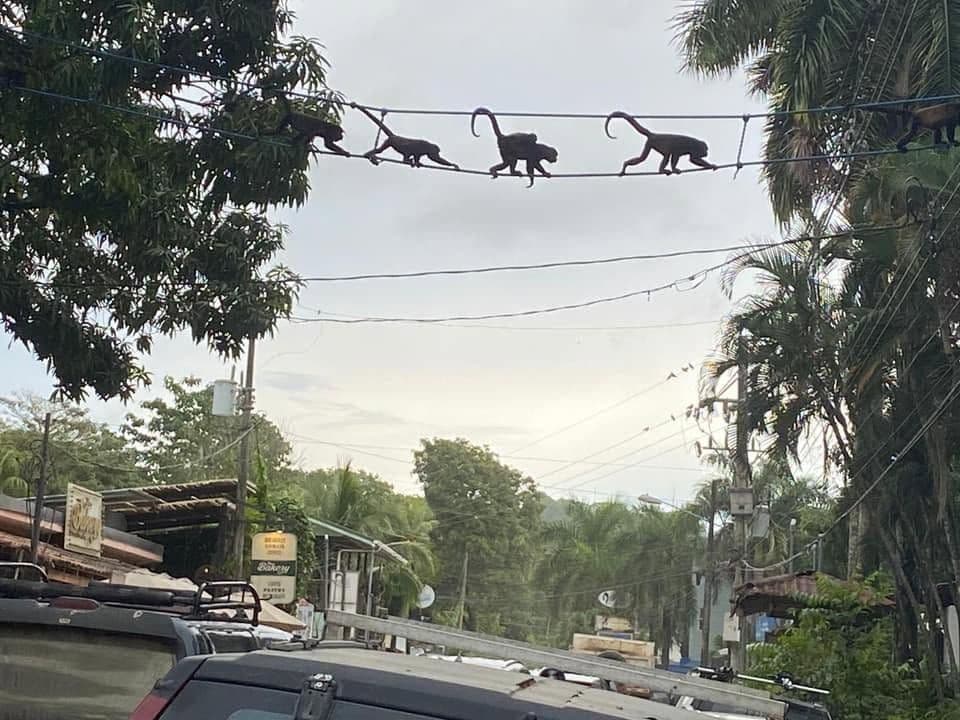
On Tuesday, lawmakers agreed on a bill during their second discussion that requires all public infrastructure, both new and existing projects, to ensure safe passage for wild animals.
Monkey Trail Bridge Crossing
It is a necessary and top priority action in relation to important sites where technical studies have shown that roads divide up natural habitats and put terrestrial and aquatic wildlife species at risk.
The second debate on the issue was initially set for last April, but it was blocked by the official party group and a number of allies in order to avoid imposing sanctions on then-legislator Fabricio Alvarado, who was being accused of sexual abuse. It was therefore not possible to give the bill its final approval at that time.
The bill was also almost abandoned, but it was saved in early June when a motion to extend its four-year deadline was passed, which kept the initiative alive and enabled the final vote to take place.
The bill known as 23.166, which was first introduced by Ariel Robles of the Broad Front (Frente Amplio, FA), stipulates that public infrastructure projects must include, from the very beginning, the expenses involved in putting into effect and keeping wildlife crossings.
The Ministry of Public Works and Transportation (MOPT) and the various local municipalities should co-ordinate directly with the National System of Conservation Areas (Sinac), and the National Environmental Technical Secretariat (Setena) must take responsibility for making sure that these environmental obligations are included as a mandatory requirement when environmental approval is granted for projects.
The proposal gives Sinac a 24-month deadline to urgently identify natural wildlife crossings on existing road networks.
Edgardo Araya, a member of the Broad Front, stated during the debate on the bill that the sensitivity of a society can be judged by the degree of concern it shows for other beings with whom we share the planet.
Araya pointed out that the Universidad Latina has recorded more than 19,000 cases of wild animals being killed on the roads, while organizations such as SalveMonos documented 1,552 incidents between 2011 and 2025, the majority of them being electrocutions, 85% involving primates.
Ariel Mora from the Sovereign People’s Party (PPSO) stressed the importance of improving the time taken to rescue animals that have been hit by vehicles and guaranteeing access to shelters.
Mora posted a video of an ocelot that he had found had been hit by a car on the road; initially he thought the animal was dead but it later came to its senses. The legislator took the cat to a shelter, where it was eventually given a lethal injection a few days later because of its injuries.
Ángela Aguilar, a member of the Liberation Party, pointed out that since Costa Rica hosts more than 6% of the world’s biodiversity, it also has the most dense network of roads in Central America; hundreds of these roads go through forests and interrupt the natural corridors that wildlife needs in order to move, feed and reproduce, thus increasing the risks facing the animals.